 PRODUCT
MyDineSpace
From an overwhelmed restaurant to a QR-first workflow for customers, kitchen staff and owners, with restaurant-branded billing.
01 / The problem
Where the friction starts.
While waiting to order, I saw a small restaurant team struggling with a crowd and re-entering order and bill details into a laptop. I researched existing QR systems, then explored how connected workflows could reduce that repeated entry. This was firsthand problem discovery; measured efficiency gains remain unproven.
02 / The experience
A more useful way through.
The Restaurant OS is designed around browser-based QR ordering, distinct kitchen and owner surfaces, and branded bills. The public website and fictional menu demos let visitors explore the presentation; they do not demonstrate a restaurant operating commercially.
The intended value is a clearer handoff from ordering to billing. The complete flow was reported working by the founder on 1 November 2026; a completed restaurant pilot and business outcomes have not been established.
03 / The workflow
- 01Customer: scan a table QR and browse without installing an app
- 02Customer: send an order into the restaurant workflow
- 03Kitchen and service: receive and track the order in role-specific surfaces
- 04Owner: review the order and generate a restaurant-branded bill
Adapted to the business
Technology & integration areas
Browser-based QR entry / Role-specific workflows / Branded billing
04 / Current evidence
Real Project
Public marketing and both fictional design demos inspected on 2 November 2026. Restaurant OS staging milestones are documented separately; the 1 November order-to-bill test is founder reported. Authenticated operations and real payment settlement were not replayed in this review.
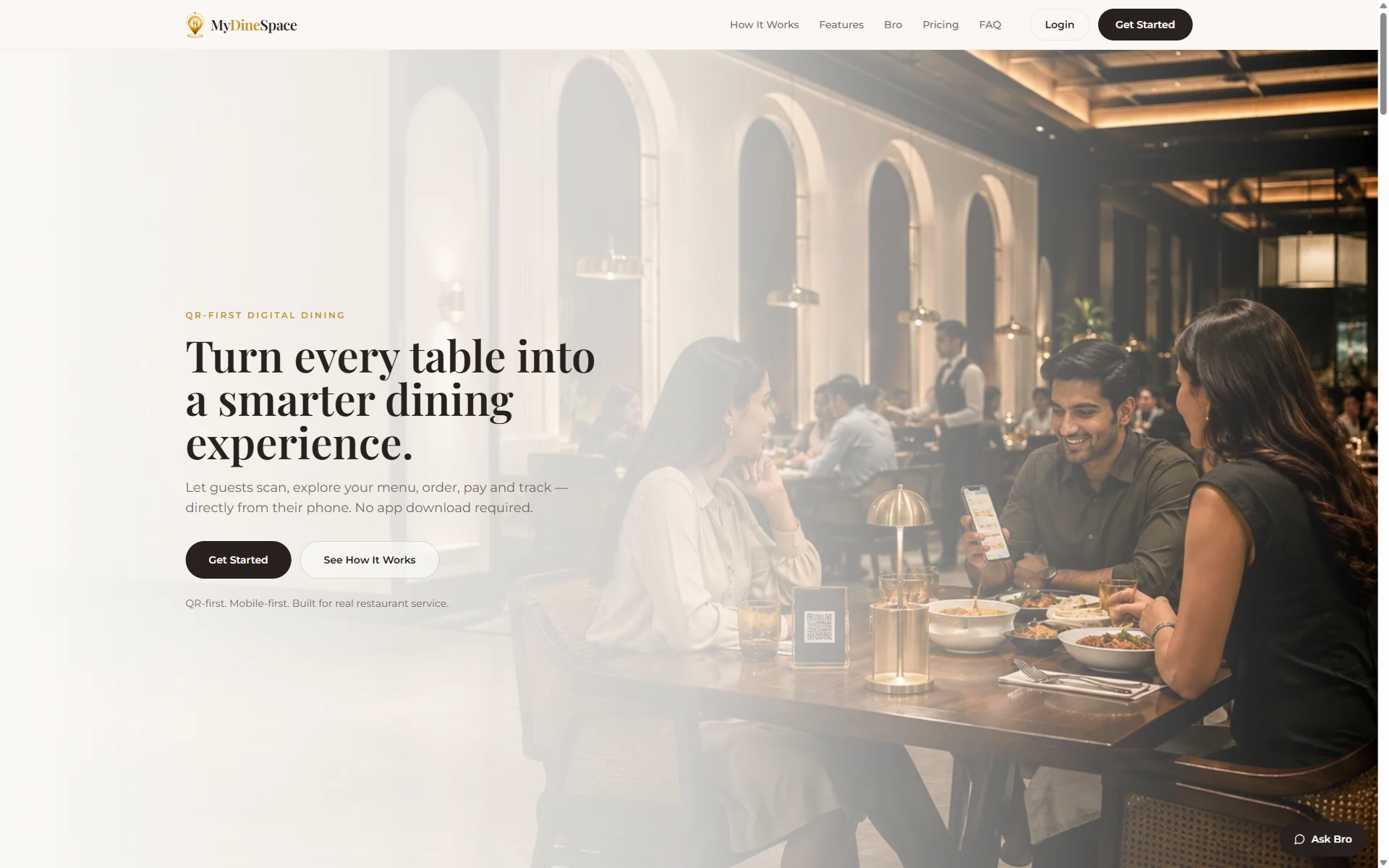
Public marketing homepage · captured 2 November 2026. Product images within the marketing page are not independent evidence of Restaurant OS operations.
- Browser inspectedPublic website and interactive designs
- Marketing, the five-dish Customer Experience and the three-dish Indian Food Rotator were inspected on 2 November 2026. The demos explicitly state: fictional menu, no real ordering.
- Documented stagingRestaurant OS / table QR
- Internal records describe signed table-QR checks and a green staging gate on 1 September 2026. Those historical checks were not rerun here.
- Founder reportedOrder → dashboard → branded bill
- The founder reported a working end-to-end test on 1 November 2026. A dated, redacted recording and matching application revision remain to be attached.
- PendingRestaurant adoption
- No completed physical restaurant pilot, paying-customer evidence, measured time savings or production settlement is established.
05 / My contribution
Decisions I owned.
I independently directed discovery, product scope, UX direction, technical choices, debugging and deployment, using AI extensively for research, architecture and code generation. The work is an individual, AI-assisted build; exact Restaurant OS implementation and CI claims still need source-linked release evidence.
06 / Engineering decisions
Why the system takes this shape.
- Narrow the first operating workflow
- I began with a multi-vendor Food Court OS. Unresolved payment handling across vendors led me back to the single-restaurant problem I had observed. The food-court payment work remains unfinished.
- Design around each role
- Customers need low-friction QR access; kitchen and service staff need order context; owners need oversight and billing. Separate surfaces reflect those different jobs.
- Connect the bill to the order
- Restaurant-branded billing is part of the intended order-to-dashboard flow, rather than repeated manual entry. The full workflow is founder-reported, pending a redacted replay.
- Keep payment states explicit
- Razorpay was used with developer/test APIs, without real-money transactions. Direct merchant UPI and cash depend on owner confirmation; automatic UPI reconciliation is not verified.
07 / Limits & learning
What still needs proving.
- Commercialization is paused. Restaurant interest did not become a completed adoption pilot.
- The public design demos exercise presentation, not ordering, kitchen operations or billing.
- Payment webhook verification, idempotency and account routing require a code review before stronger claims.
What I learned
A QR menu becomes a much larger engineering problem once roles, order state and payment boundaries interact. Narrowing scope helped, but technical progress did not replace the missing owner follow-up and real restaurant validation.