 PRODUCT
Kraantidhara
A public website for a youth-led social action initiative in Odisha, organised around purpose, field work and evidence.
01 / The problem
Where the friction starts.
Social action needs a public home that explains the purpose and makes documented work easy to find and revisit.
02 / The experience
A more useful way through.
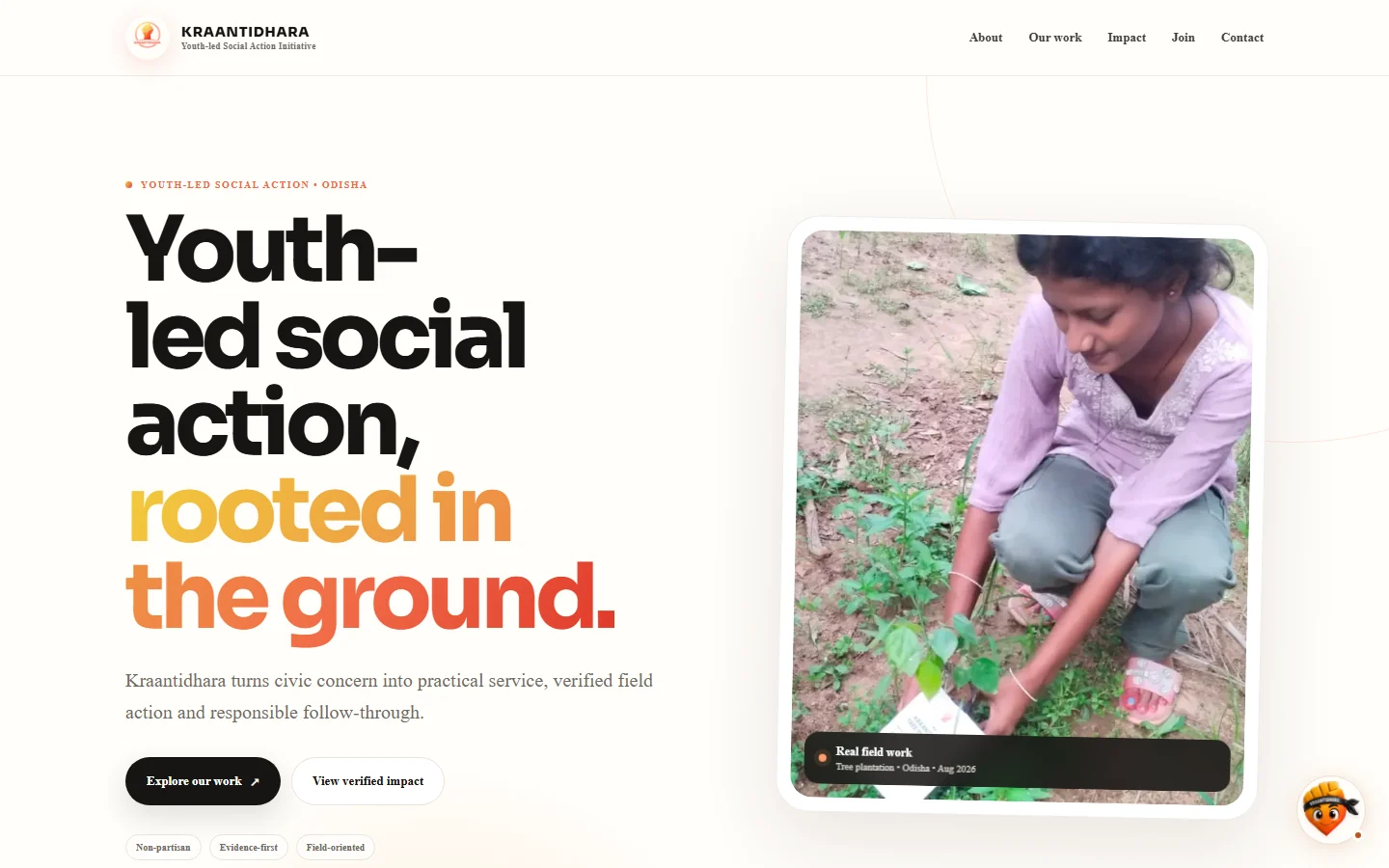
Field-led imagery introduces the initiative. Dedicated work and impact pages connect programmes to documented action and follow-up.
Shows how information architecture and real project material can make a civic initiative understandable and accountable.
03 / The workflow
- 01Understand the initiative
- 02Explore programmes
- 03Read action records
- 04Find participation and contact paths
Website content areas
Technology & integration areas
Next.js App Router / React / TypeScript / CSS / Tailwind tooling / Shared content modules
04 / Current evidence
Real Project
Public homepage, Our Work and Impact routes checked on 4 November 2026. Desktop and mobile captures show the live website. Local source and development history were inspected separately; an exact match to the deployed revision has not been established. The website is separate from the Kraantidhara Digital Operator concept, which remains in development.
Live public homepage · captured 4 November 2026. Field records belong to the initiative; they are not portfolio delivery metrics.
- Browser inspectedLive homepage
- The public introduction, navigation, work and impact links were inspected on 4 November 2026. Desktop and mobile screenshots are available below. Inspect live homepage (new tab)
- Browser inspectedOur Work
- The live page groups environment, service, civic action and remembrance, then links to the initiative’s public record. These are website content areas, not a list of independently validated programmes. Inspect our work (new tab)
- Browser inspectedImpact and transparency
- The route presents the initiative’s campaign documentation and pending follow-up. Its reported figures have not been independently audited in this portfolio review. Inspect impact and transparency (new tab)
- Source inspectedImplementation and contribution
- Next.js routes, shared data, responsive header, metadata and author history inspected on 4 November 2026. Source is private; no public repository is linked. Source presence does not establish the deployed revision.
05 / My contribution
Decisions I owned.
I developed the public website’s page structure, responsive presentation and shared content model. My development history includes media-rendering fixes, the Resources presentation, publication metadata and a configurable site origin. This case study covers that website work; it does not establish that I delivered every field activity described by the initiative.
Technical architecture
The inspected source uses Next.js App Router with React and TypeScript. Shared site, navigation and media data feed the homepage, work and impact pages; reusable header, footer and page-intro components keep the pages consistent. The header uses a native details/summary menu on smaller screens, and route metadata supplies page titles, descriptions and canonical paths. Later publication routes exist in source but are not claimed as verified live features.
06 / Engineering decisions
Why the system takes this shape.
- Give purpose, programmes and records different jobs
- The homepage introduces the initiative, Our Work groups its activity areas, and Impact presents the initiative’s documentation and follow-up status. Keeping these routes distinct makes the public information easier to inspect without treating a programme description as proof of an outcome.
- Share content instead of repeating it across pages
- Navigation, campaign references and media paths live in shared source modules. Pages render that structured content with reusable components, making updates less dependent on editing several unrelated layouts.
- Make field media work across screen sizes
- The source supplies image dimensions, alternative text and responsive sizes. Development commits address media rendering. The gallery shows the actual public homepage and work page at desktop and mobile widths; it does not independently validate the field records pictured elsewhere on the site.
- Keep public browsing separate from participation
- Visitors can read the public pages without an account. Join and contact paths hand off to the initiative’s communication channels; no membership database, automated verification service or Digital Operator integration was verified.
07 / Limits & learning
What still needs proving.
- The public website is verified; the Digital Operator remains a separate in-development concept.
- Organizational participation, beneficiaries, field outcomes and survival follow-up are not independently validated engineering results.
- The local source contains later publication work. Its availability on the public deployment and exact release revision remain unverified.
- Participation forms were not submitted, and private organizational records were not accessed or captured.
What I learned
For this website, information architecture is part of truthful communication: purpose, documented action and pending follow-up need distinct places. Shared content and predictable media presentation help maintain that distinction, while a local implementation still needs a separate deployment check.
08 / Actual screenshots
From the public implementation.
Captured directly from the public website on 4 November 2026. Open a screen to inspect it; use the arrow keys to move and Escape to close.
Desktop homepage · the initiative’s introduction and links to work and impact. Captured 4 November 2026.
Mobile homepage · the same public introduction at 390 × 844. Captured 4 November 2026.
Desktop Our Work · the introduction and opening programme cards. Programme descriptions do not independently prove field outcomes. Captured 4 November 2026.
Mobile Our Work · public programme cards at 390 × 844. Captured 4 November 2026.