 PRODUCT
GutFoodScore
A public food scoring product built by Shibanugrah to make everyday food information easier to explore.
01 / The problem
Where the friction starts.
Food information is often scattered or difficult to compare during an everyday choice.
02 / The experience
A more useful way through.
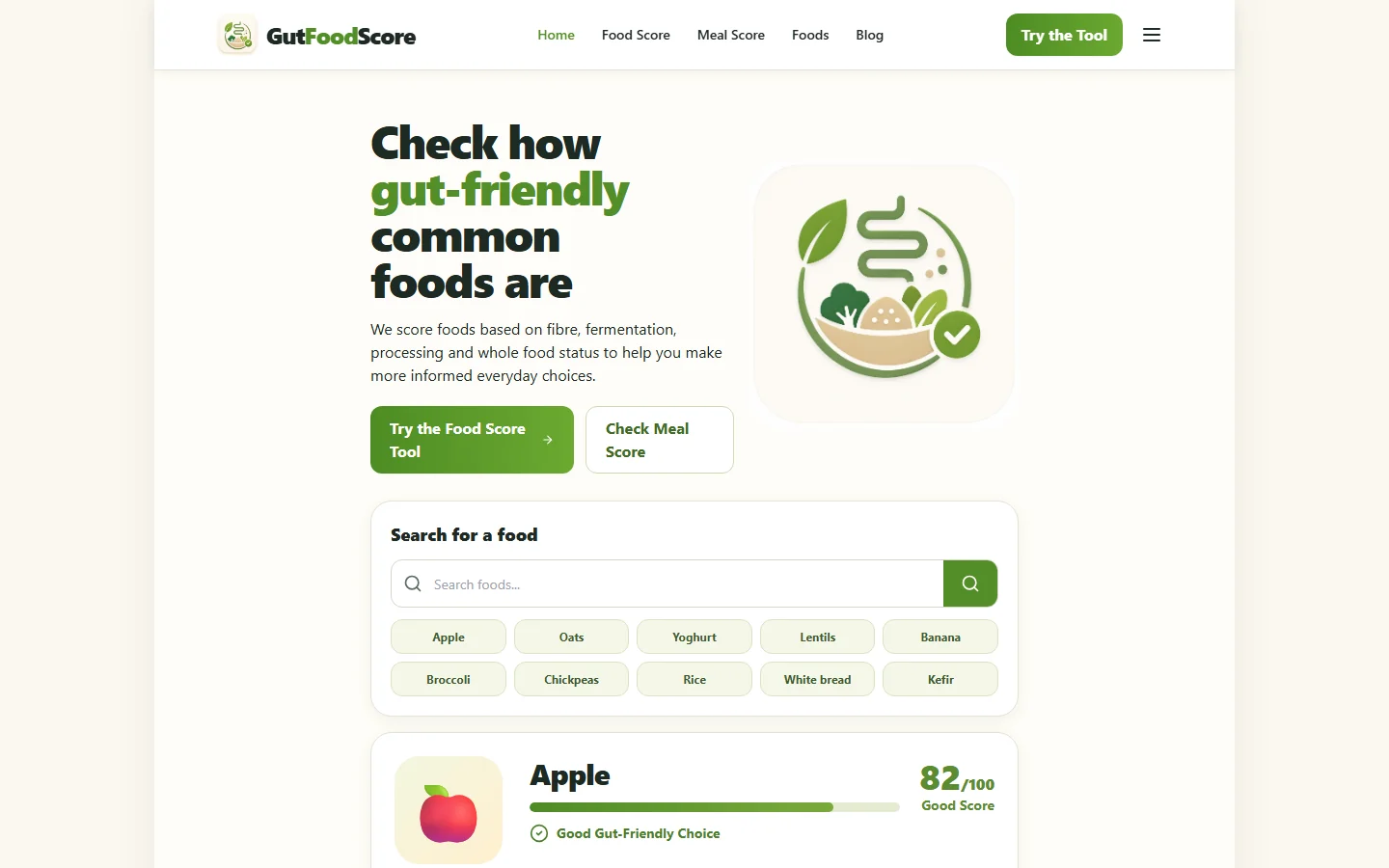
Visitors can search common foods, inspect a gut-friendly score and its contributing traits, and explore a separate browser-only meal score.
Brings a food catalogue, scoring explanation and meal exploration into one navigable public product.
03 / The workflow
- 01Search for a common food
- 02Read its score and food traits
- 03Explore the educational explanation
- 04Check a combination of foods in Meal Score
Product areas
Technology & integration areas
React / Vite / React Router / Tailwind CSS / Structured food data / Browser-side calculation
04 / Current evidence
Real Project
Public homepage, food search, Apple detail and the default example-meal calculation inspected on 4 November 2026. Local source and author history were reviewed separately. The gallery contains actual public-site captures, including an example result; scores are educational product output, not evidence of clinical accuracy or a health outcome.
Captured from the live public website · 4 November 2026
- Browser inspectedHomepage and food search
- Public food search, quick-food choices and the displayed food card were checked on 4 November 2026; the gallery shows desktop and mobile entry screens. Inspect homepage and food search (new tab)
- Browser inspectedFood detail
- Apple’s public detail page shows the product’s educational score presentation and explanatory sections. The displayed score is product output, not an independently verified nutritional measurement. Inspect food detail (new tab)
- Browser inspectedExample meal workflow
- The supplied example meal was opened and Calculate My Score led to the results route on 4 November 2026. The mobile result screenshot contains example foods, not user records. Inspect example meal workflow (new tab)
- Source inspectedImplementation and review states
- React routes, food search utilities, review-state rendering, metadata and the meal module were inspected on 4 November 2026. Source is private and its exact deployed revision is not established.
05 / My contribution
Decisions I owned.
I built GutFoodScore as my own educational web product. The inspected implementation and my source history cover food catalogue and score presentation, searchable food pages, review-state handling and the meal exploration flow. The work brings product structure, frontend implementation and content validation together; it does not establish nutrition expertise or clinical validation.
Technical architecture
The inspected source is a React application built with Vite, React Router and Tailwind CSS. Shared food data feeds search, results and slug-based detail pages. Food utilities handle matching, display eligibility and review states. A separate browser-side meal module calculates the example meal breakdown, and React Router carries the meal selection into the results page. Route-level titles, descriptions and canonical handling support discovery. No account or backend is needed for the demonstrated calculation.
06 / Engineering decisions
Why the system takes this shape.
- Show context alongside the score
- The live food card combines a score, food traits, explanatory text and a link to the full food page. The number is presented as an educational summary, with a visible medical-advice disclaimer, rather than as a personal health assessment.
- Represent missing evidence explicitly
- The inspected source distinguishes active, provisional and under-review food entries. Display checks can withhold an unavailable score, and food detail metadata changes indexing eligibility by review state. These are source-reviewed safeguards; every review state was not replayed on the live deployment.
- Keep meal exploration in the browser
- The meal interface starts with example foods grouped by meal. Calculate My Score opens a result and a category breakdown. Source inspection confirms a client-side calculation over structured food traits; this review used the supplied example rather than anyone’s dietary history.
- Keep catalogue scoring and meal scoring distinct
- Food search uses the pilot catalogue, while the meal calculator uses its own food-data module. That separation is visible in source and is a consistency risk to manage; the case study does not imply that every searchable food is supported identically in a meal.
07 / Limits & learning
What still needs proving.
- Educational product only: no clinical accuracy, diagnosis, health improvement, usage or commercial result is claimed.
- The meal calculation is a heuristic over supported food data. It does not establish portion-aware nutritional analysis or personalized dietary guidance.
- Catalogue and meal datasets are separate in the inspected source; complete coverage and consistency still need verification.
- Review-state safeguards were inspected in source; all catalogue entries and deployed review states were not tested.
What I learned
A score needs an explanation, an uncertainty state and clear limits. Keeping the search, food detail and meal workflow understandable matters as much as producing a number. Shared validation is the next area to strengthen where the catalogue and meal datasets diverge.
08 / Actual screenshots
From the public implementation.
Captured directly from the public website on 4 November 2026. Open a screen to inspect it; use the arrow keys to move and Escape to close.
Desktop homepage · food search and the default Apple card. Numbers are educational product output. Captured 4 November 2026.
Mobile homepage · public food exploration at 390 × 844. Captured 4 November 2026.
Desktop food detail · Apple’s score presentation, context and disclaimer. Captured 4 November 2026.
Desktop Meal Score · the product’s supplied example foods; no personal dietary records. Captured 4 November 2026.
Mobile meal result · reached through Calculate My Score using the supplied example. This is a heuristic demonstration, not clinical validation. Captured 4 November 2026.